From Chatbot to Autopilot
Until recently, AI worked like this: you ask something, it answers. You're doing the driving, the AI is the passenger giving directions.
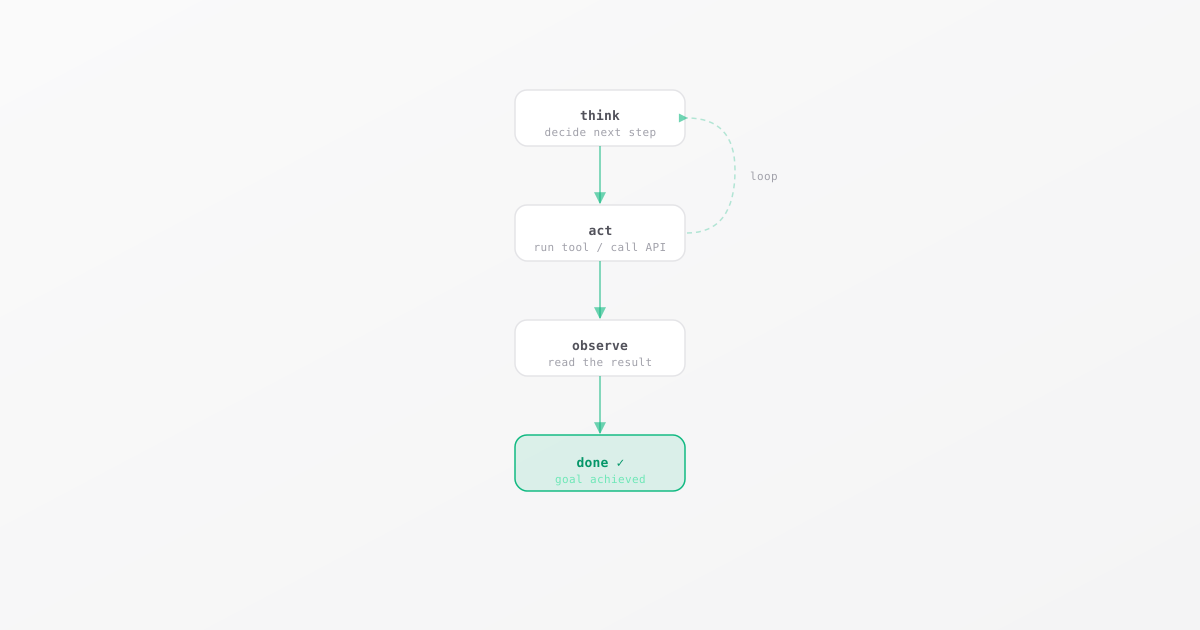
AI agents flip that around. You give the AI a goal — "book me a dentist appointment" or "find the three best Python tutorials for beginners" — and it figures out the steps and takes them itself.
To do this, agents are given tools: the ability to search the web, open files, write and run code, click buttons, fill out forms. The AI decides which tools to use and in what order.
A Concrete Example
Say you ask an agent: "Find me three internship opportunities at tech companies in Toronto."
Here's what it might do on its own:
- Search Google for "tech internships Toronto 2026"
- Open the top results
- Read each page to find relevant details
- Summarize and format the results for you
Each step is an action the AI takes automatically. You just described the goal.
This is genuinely useful — and also the reason agents sometimes cause problems.
Why Agents Can Go Wrong
The same thing that makes agents powerful makes them risky: they act without asking permission for every step.
A few real things that have happened with agent tools:
- An agent sent a draft email as a final email because it misread the instruction "send when ready"
- An agent deleted files it thought were temporary but were actually important backups
- An agent booked the same appointment three times while trying to confirm the first one
None of this is the AI being "evil." It's the AI completing the task as it understood it — which wasn't quite how the human meant it.
The rule of thumb engineers use: if an action can't easily be undone, make a human approve it first.
What Are Agents Actually Good At Right Now?
Works well:
- Research tasks (summarize websites, compare options)
- Writing and editing code based on a description
- Filling out repetitive forms or spreadsheets
- Answering questions from a large document (like a textbook or contract)
Still pretty unreliable:
- Anything involving real money or bookings
- Long multi-step tasks with no human check-in
- Tasks where "close enough" isn't good enough
Why Students Should Care
A lot of entry-level jobs involve repetitive information work — research, data entry, summarizing documents. Agents are getting good at exactly those tasks.
That doesn't mean the jobs disappear. It means the people who know how to direct and check agents will be more valuable than people who just do the tasks manually. Understanding what agents can and can't do is becoming a genuinely useful skill.